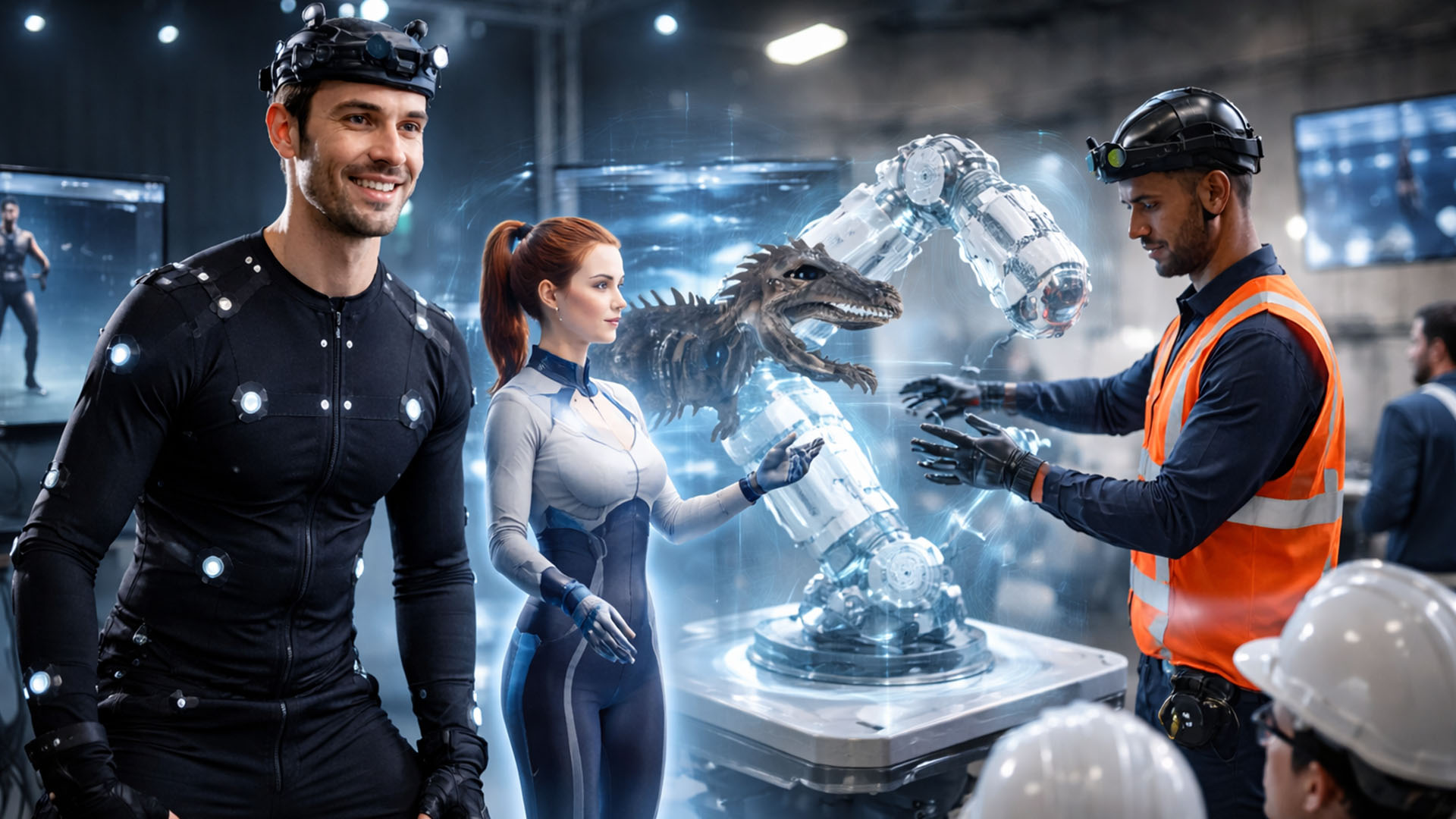
Motion Capture Technologies and Their Application in Advertising and Education
Motion capture (mocap) is a technology used to record the movements of a person or object and transfer this data to a digital model. As a result, real gestures, walking patterns, facial expressions, and motion dynamics are transformed into precise animations of 3D characters, mechanisms, or virtual objects.
Originally, motion capture was used primarily in film and the gaming industry, but today it is actively applied in advertising, education, museum exhibitions, VR/AR projects, and corporate training. This shift is driven by the growing demand for visual, interactive, and emotionally engaging content formats.
How Motion Capture Technologies Work
There are several main approaches to motion capture:
Optical Motion Capture
An actor wears a suit with markers that are tracked by cameras. Specialized software reads the position of the markers in space and generates digital animation.
Pros: high accuracy, detailed motion capture
Cons: high cost and the need for studio conditions
Inertial Motion Capture
This method uses sensors (gyroscopes and accelerometers) attached to the body. No cameras are required.
Pros: mobility, the ability to record in almost any environment
Cons: lower accuracy in complex interactions
Facial and Gesture Capture
Dedicated systems record facial expressions as well as hand and finger movements, which is especially important for guide characters and educational avatars.
Applications of Motion Capture in Advertising
Animated Characters and Brand Heroes
Motion capture makes it possible to create realistic digital characters that move and interact with audiences almost like real people. Such characters are used:
- in advertising videos,
- on interactive displays,
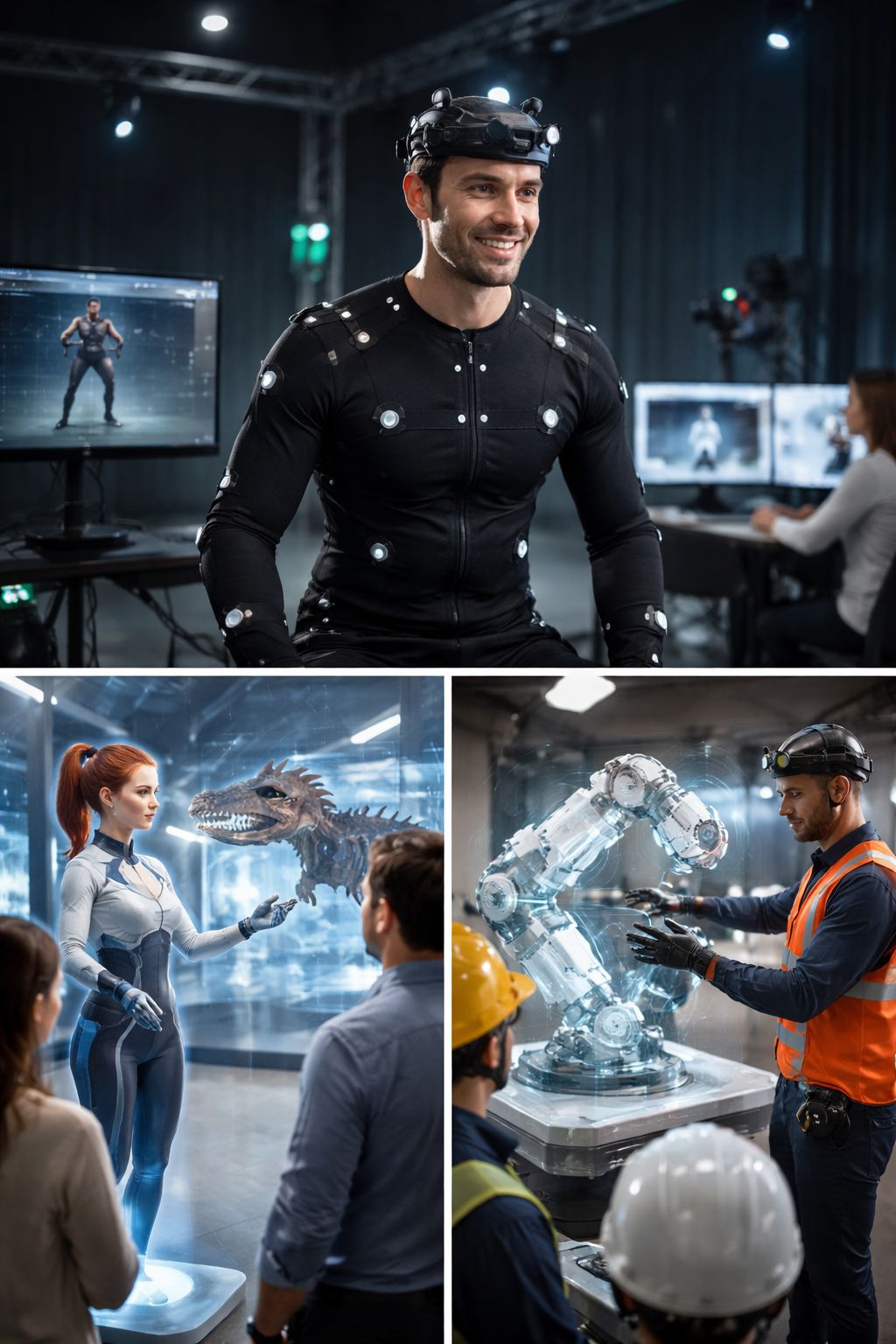
- in digital showcases and showrooms.
Natural movement increases trust and emotional engagement.
Guide Characters and Virtual Consultants
Virtual guides with mocap animation can:
- greet visitors,
- explain a product or service,
- accompany users through digital environments.
This approach is especially effective for exhibitions, shopping centers, museums, and presentation areas.
Demonstration of Complex Processes
Advertising high-tech products often faces a challenge: invisible or complex processes are difficult to explain with words alone. Motion capture animation combined with 3D graphics makes it possible to show:
- how equipment works,
- production stages,
- human interaction with a product.
Motion Capture in Education and Training
Virtual Tours and Interactive Lessons
Using motion capture, it is possible to create virtual tours where a guide character:
- leads users through a space,
- reacts to their actions,
- explains content in clear, accessible language.
This format works particularly well in schools, museums, science centers, and educational platforms.
Demonstration of Processes and Experiments
Motion capture allows for clear visualization of:
- physical and chemical processes,
- how the human body functions,
- actions performed in laboratory or industrial environments.
This is especially valuable in cases where real experiments are expensive, dangerous, or impossible.
Training for Working with Complex Mechanisms
In industrial and corporate training, motion capture is used for:
- step-by-step demonstrations of equipment assembly and disassembly,
- safety training,
- practicing personnel actions in virtual environments.
Realistic motion significantly improves learning outcomes and reduces the number of errors.
Why Mocap Is an Effective Communication Tool
- Clarity — information is perceived faster than text or static images
- Emotional engagement — lifelike movement builds trust and interest
- Flexibility — content can be easily adapted for different formats and screens
- Scalability — a single mocap asset can be reused in advertising, training, and presentations
The Future of Motion Capture in Advertising and Education
With the development of VR, AR, and transparent display technologies, motion capture is becoming part of a new visual environment where digital characters and processes interact seamlessly with real space.
In the coming years, motion capture will be increasingly used:
- in next-generation educational environments,
- in interactive museums and science centers,
- in brand communications focused on experience rather than just the product.